
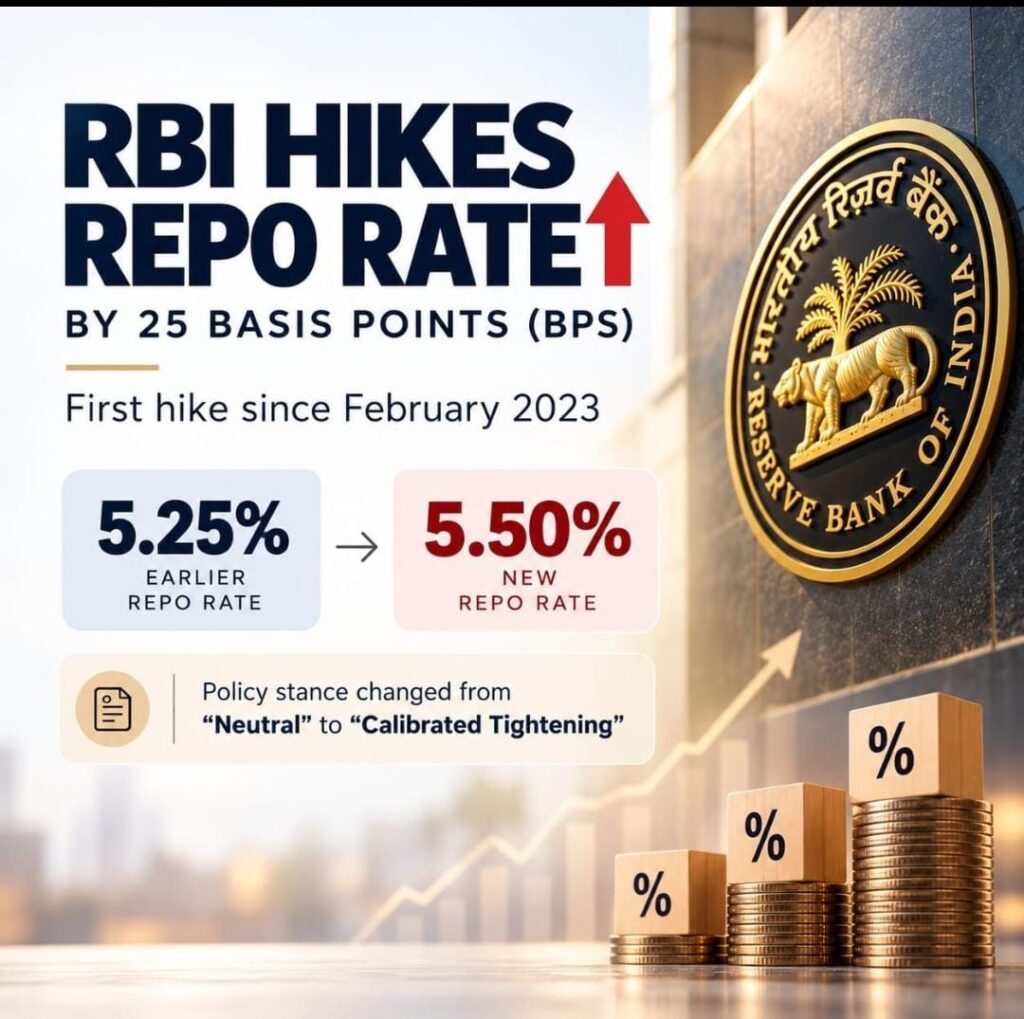
Reserve Bank of India (RBI) raised the Repo rate by 25 basis points marking its first rate hike since February 2023, here all you need to know about it
RBI hikes Repo Rate by 25 bps. What does it really mean for businesses?
The RBI has taken a significant turn in its monetary policy in Oct 2026
The Monetary Policy Committee has increased the Repo Rate by 25 basis points, from 5.25% to 5.50%, the first hike since Feb 23.
More importantly, the policy stance has moved from “Neutral” to “Calibrated Tightening.”
But the bigger story is not just the 25 bps.
What is RBI responding to?
Inflationary risks are becoming more relevant again, particularly with pressures from crude oil, food prices and global geopolitical developments.
At the same time, the RBI remains confident about India’s growth momentum:
FY27 GDP growth projection: 7.1%
FY27 inflation projection: 5.2%
So, this is essentially a balancing act:
Strong growth + rising inflation risks = cautious tightening.
What does this mean for businesses?
For businesses with floating-rate loans or other benchmark-linked borrowings, the cost of funds could move higher as lending rates transmit the policy change.
And this is where working capital management becomes even more important.
A few areas worth reviewing from a business perspective:
- Receivable collection cycle
- Inventory holding period
- Supplier credit terms
- Cost of borrowing
- Utilisation of working capital limits
- Difference between sanctioned limit and actual utilisation
Because in a rising-rate environment, idle borrowing can become expensive borrowing.
For MSMEs, this is a good time to revisit the entire working capital cycle.
The objective should be to use capital more efficiently.